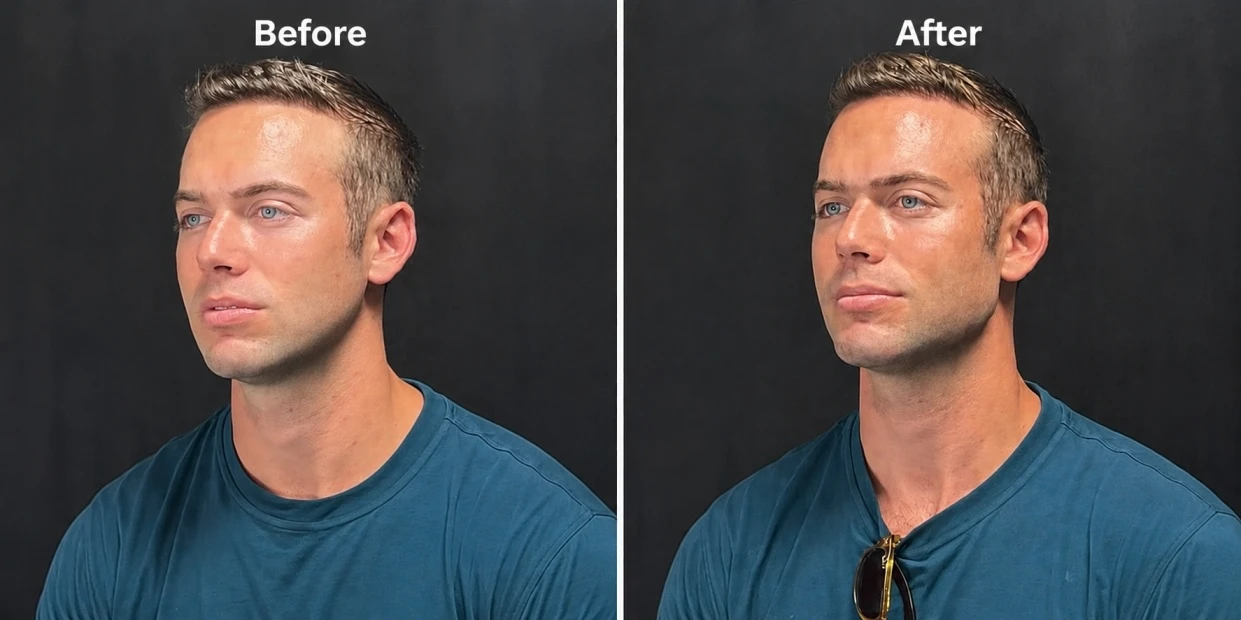


In facial rejuvenation, patients no longer want to appear or look younger; they desire to appear natural, refreshed, and untouched. This demand has created an increased interest in the deep plane facelift treatment, which is sometimes referred to as a traceless facelift. But what exactly is a deep plane facelift, and why does this technique always provide results that are hard to detect?
Let’s break it down…
Deep plane facelift procedure is a more complex type of surgery that treats aging on the facial skin, at the level of the SMAS (Superficial Musculoaponeurotic System) and deeper facial ligaments. The skilled cosmetic surgeon does not pull the skin tight (as in older facelift methods); he liberates and rearranges the underlying facial framework, the same structure that naturally descends with age.
Because the skin is not the primary target of tension, it is allowed to redrape naturally, which is the foundation of a traceless result.
When no traces of surgery can be seen, even with the naked eye, a facelift procedure will look "traceless”. Some key principles can attain the deep plane facelift technique:
Conventional facelifts are very dependent on skin tightening, which usually results in:
In a deep plane facelift, tension is laid on the deeper tissues, not the skin. This allows:
This is one of the most significant changes in tension, which is the reason the results look undetectable.
Old age leads to the midface, jawline, and neck to descend as a unit. The deep plane facelift treats aging as a structural issue, not a surface problem.
The face is brought back to youthful anatomy by letting go of facial retaining ligaments and aligning the cheeks and jawline into place in unity instead of tightening the face artificially. This avoids:
The result looks like you, just well-rested and refreshed.
A “traceless facelift” is also known as invisible scarring.
Incisions heal better since the skin is not strained much. Cosmetic surgeons place them:
Lower tension = smaller scars, which make them extremely difficult to spot even with short hairstyles.
Limited and unnatural movement is one of the greatest giveaways of the traceless facelift. Deep plane facelifts do not destroy the normal facial mechanics since:
“You look gorgeous—Have you switched your skincare?”
rather than
“Did you have surgery done?”
That is the typical feature of a traceless facelift result.
Since the deep plane facelift involves correction of the underlying cause of aging, the outcome is likely to be much longer-lasting than the other superficial ones. This minimizes repetitive processes, which may increase surgical signs with time.
Longevity is a source of tracelessness-patients do not seek results, and faces don’t become progressively altered.
The method is especially useful with those people who:
Traceless Deep flane facelift is a great alternative for patients who desire to have their midface rejuvenated, which traditional facelifts fail to address properly.
It is very important to choose a professional cosmetic surgeon because a deep plane facelift is technically challenging. The results of traceless acelift are highly dependent on:
When you are in the right hands, the deep place facelift procedure may produce life-altering, yet invisible results.
A traceless deep facelift procedure is said to be traceless since it does not act with facial anatomy, but rather against it. By lifting deeper structures, minimizing skin tension, preserving natural movement, and hiding scars intelligently, it produces results that look effortless and authentic.
For patients seeking rejuvenation without tell-tale signs of surgery, the deep plane facelift represents the gold standard of natural facial restoration—where the best compliment is not being noticed at all.

ROYAL COLLEGE OF
SURGEONS

MEDICAL UNIVERSITY OF SOUTH
CAROLINA

UNIVERSITY OF SOUTHERN
CALIFORNIA

AMERICAN ACADEMY OF
COSMETIC SURGERY

AMERICAN SOCIETY OF
LIPOSUCTION SURGERY