



Aesthetic Logo

Aesthetic & Cosmetic Surgery · Los Angeles

Awake Breast Augmentation

Awake, office-based surgical transformations led by Dr. Saurabh Jain. Tailored anatomy-focused care with natural precision and minimal downtime.

Awake Breast Augmentation

Understanding Your Implant Options

Every modern breast implant has a silicone shell. What differs is the filling, and each type involves trade-offs.

Saline implants: The shell is filled with sterile salt water, usually after it is placed, which allows a slightly smaller incision. If a saline implant leaks, it deflates noticeably and the body safely absorbs the water. The trade-offs are a firmer feel and a higher likelihood of visible rippling, especially in thin patients. Saline may suit patients aged 18 to 21, those who prefer a smaller incision, or those who prefer the lower cost.

Silicone gel implants: The filling is a soft, cohesive gel that most closely resembles the feel of breast tissue. This is the most commonly chosen option, and it tends to ripple less than saline. The trade-off is that a rupture may cause no obvious change, so follow-up imaging matters. Silicone is generally a good fit for patients who want the most natural feel, including those with less natural breast tissue.

Highly cohesive silicone implants ("gummy bear"): These contain a firmer gel that holds its shape. They can be round or teardrop-shaped and may suit patients who want more controlled shape or have thin tissue. Limitations include a firmer feel, a slightly longer incision, and, with teardrop shapes, the possibility of rotation inside the pocket. As with other silicone implants, rupture can be silent.

Shape, surface, and size: Round implants add fullness in the upper breast, while teardrop implants follow a more sloped contour. Smooth implants are used in most augmentations. Textured implants have been associated with BIA-ALCL, a rare lymphoma, so they are used only when there is a clear reason.

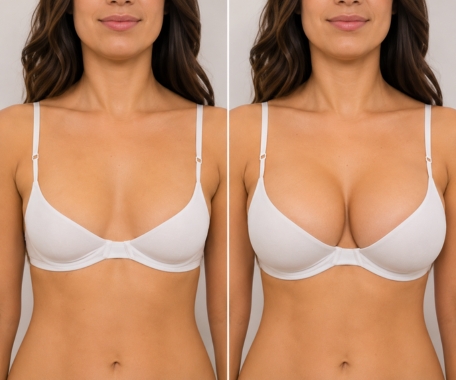
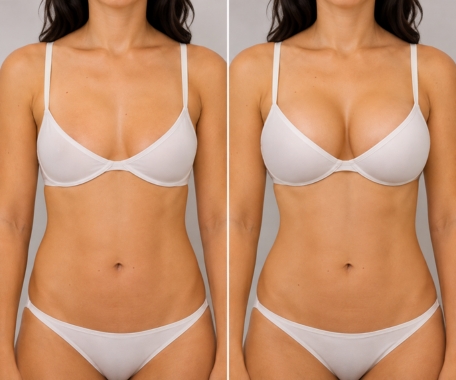
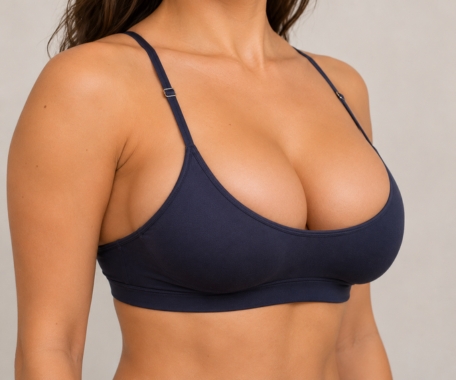
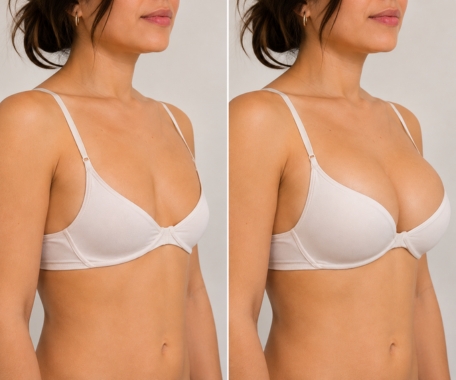
Implant size is measured in cubic centimeters (cc), not cup size. Bra sizing varies between brands, and the same volume can look very different on different frames, so there is no reliable conversion from cc to cup size. Dr. Jain selects volume and profile after measuring your chest width, tissue, and skin, and you will try sizes in a bra during your visit to preview the change.
Schedule Your Visit

Book an Appointment

Confidential one-on-one consultation with Dr. Saurabh Jain.

About the Procedure

Choosing Breast Implants: Where a Good Result Begins

The best breast augmentation results start with an honest conversation about what you hope to change and what your anatomy can realistically support. Implant size, material, placement, and incision are all decisions that should follow from that conversation, not precede it.

Dr. Saurabh Jain performs awake breast augmentation for patients across Los Angeles and the San Fernando Valley. In this approach, implants are placed under local anesthesia with light oral sedation, as an outpatient procedure, for patients who are good candidates. Dr. Jain has spent more than ten years in aesthetic procedures and cosmetic surgery, and he will tell you in detail whether implants are the right step for you.

  • —
    Awake Office Surgery: No general anesthesia, comfortable local numbing.
  • —
    Bespoke Precision: Sculpted precisely to your natural bodily anatomy.
  • —
    Rapid Recovery: Return to routine daily activities faster and refreshed.
Awake Breast Augmentation: Benefits and Limitations
01

Awake Breast Augmentation: Benefits and Limitations

Awake breast augmentation uses the same implants, incisions, and surgical steps as augmentation performed under general anesthesia. The difference is the anesthesia. The breasts are numbed with local anesthetic, light oral sedation may be added, and you are monitored throughout. You do not need a breathing tube.

Potential benefits: Some patients prefer to avoid general anesthesia and the grogginess or nausea that can follow it. Many are alert soon after surgery and go home the same day.

Limitations: You will be awake for the procedure and may feel pressure, tugging, or hear the operating room. Some patients find this uncomfortable despite sedation. Local anesthetic and sedating medication also carry risks of their own, including allergic reaction.

Awake surgery is not inherently safer than general anesthesia, and it does not guarantee a faster recovery. Recovery depends mainly on the operation itself. Dr. Jain will recommend the anesthesia approach that is safest for you.

Eligibility

Is Breast Augmentation Right for You?

Implants may be appropriate if you are in good general health, have realistic expectations, and want more volume, fuller upper breasts, or better balance between the breasts after pregnancy, nursing, or weight loss. In the United States, the FDA approves saline implants for patients 18 and older and silicone gel implants for patients 22 and older for cosmetic augmentation. Implants are not performed during pregnancy or while nursing.

If you expect to become pregnant within the next year or so, waiting is usually advisable, since pregnancy changes breast tissue and can alter the result.

Implant Placement and Incision Options

Subglandular (over the muscle): The implant sits behind the breast tissue and in front of the chest muscle. Recovery is often a bit more comfortable, and the implant is not affected by muscle movement. However, the implant has less coverage, so rippling and edges may be more visible in patients with thin tissue.

Submuscular (under the muscle): The implant is partly covered by the pectoralis muscle, giving more coverage over the upper portion of the implant and a smoother upper slope. Soreness is typically greater early on, and flexing the chest can occasionally move the implant.

Dual plane: The upper part of the implant lies beneath the muscle while the lower part rests beneath the breast tissue. This combines upper-pole coverage with room for the lower breast to expand, and it is commonly used. Whether submuscular or dual plane placement is practical under local anesthesia is part of your planning discussion.

Incision options: Three are common:

  • Inframammary (under the breast): a scar in the breast fold, offering direct access and generally the least effect on nipple sensation and breastfeeding. This is the most commonly used approach.
  • Periareolar (around the areola): a scar at the edge of the areola, which may be less visible but can be more likely to affect nipple sensation and milk ducts.
  • Transaxillary (armpit): no scar on the breast, though it can make precise pocket control more difficult and may complicate later revision.

Every incision leaves a scar. Scars typically fade over a year or longer, and sun protection and aftercare instructions help.

The Experience

Safety and Long-Term Monitoring

Breast augmentation is common and well studied, but it is not a one-time procedure, and an informed decision begins with understanding the risks.

  • Capsular contracture: The body forms a scar capsule around every implant. In some patients it thickens and tightens, causing firmness, distortion, or pain, and may require additional surgery.
  • Implant rupture or leakage: Implants are not lifetime devices. Silicone implants can rupture without symptoms.
  • BIA-ALCL and implant-associated squamous cell carcinoma (SCC): Both are rare cancers reported in the scar capsule around implants. BIA-ALCL is linked mainly to textured implants. Report new swelling, a lump, or pain, even years after surgery.
  • Breast implant illness: Some patients report symptoms such as fatigue, joint pain, or brain fog that they attribute to their implants. A cause has not been established, and research continues.
  • Other risks: Infection, bleeding, asymmetry, rippling, implant malposition, changes in nipple or breast sensation, and re-operation. Awake surgery adds the small risks of local anesthetic and sedation.
  • FDA-recommended monitoring: The FDA advises periodic imaging for silicone gel implants: an ultrasound or MRI about five to six years after surgery, then every two to three years. Saline implant patients should monitor for changes in shape or size. The FDA also recommends that you receive and review its patient decision checklist before surgery. Please also tell your mammography technologist that you have implants.

Surgical Technique

Your Surgical Journey

Consultation: Plan on about an hour. Dr. Jain reviews your goals and medical history, examines and measures the chest, and discusses implant type, placement, and incision. You will also discuss what being awake involves and whether it suits you. If implants are not the right choice, he will say so.

Preparation: Some medications and supplements may need to be paused, and smoking and nicotine should stop beforehand because they impair healing. A mammogram may be requested depending on your age and history. Arrange for a driver and an adult to stay with you for the first day or two.

Surgery: The operation commonly takes one to two hours, and most patients go home the same day in a surgical bra.

Recovery: Healing varies from person to person and by the type of placement. Soreness and tightness are expected in the first days and can be managed with prescribed medication. Many patients return to desk work after about a week, while heavy lifting and upper-body exercise are usually restricted for several weeks. Swelling subsides gradually, and implants often settle into their final position over a few months. Dr. Jain will clear you for activities individually.

Distinction & Expertise

Why Patients Choose Dr. Jain

Dr. Jain has more than ten years of experience in aesthetic and cosmetic surgery and also trains other surgeons. His training includes the University of Southern California, the Medical University of South Carolina, and the Royal College of Surgeons, and he is a member of the American Academy of Cosmetic Surgery and the American Society of Liposuction Surgery.

In practice, that means:

  • Planning grounded in measurement. Recommendations follow a detailed examination, not a template.
  • Experience with problems. He regularly treats patients with complications or disappointing results from other practices, which shapes how carefully he plans every case.
  • Direct care. You work with Dr. Jain from consultation through follow-up.

Clinical Demonstration

Video Preview

Procedure details demonstration and surgical technique insights.

Begin Your Journey

Schedule a Private Consultation

Discover realistic, bespoke aesthetic outcomes tailored to your anatomy with Dr. Saurabh Jain.

Whatsapp icon
CallWhatsAppBook