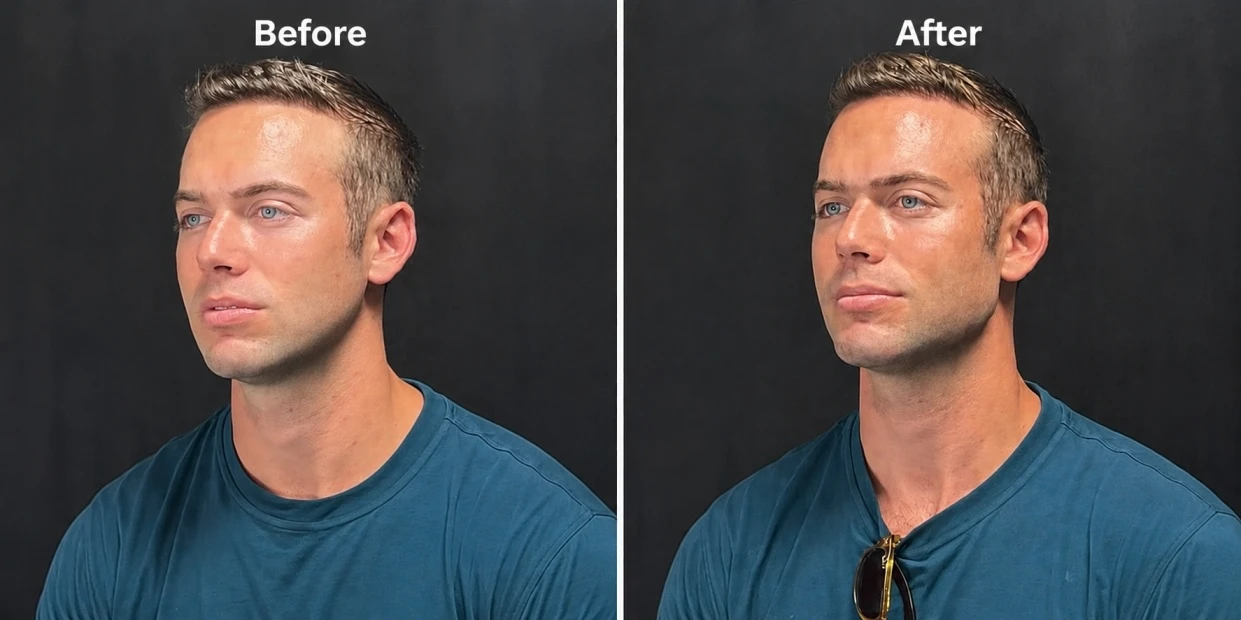


Scroll through Instagram or YouTube for five minutes, and you'll find no shortage of devices, serums, and clinic packages promising a tighter neck without any surgery. The marketing is polished, the before-and-after photos look convincing, and the price point feels far more comfortable than an operating room quote.
But if you're making decisions about your health, your face, and your money based on those promises, you deserve far more than a sales pitch. You deserve a medically grounded explanation of what these treatments actually do, where their limits are, and when a neck lift surgery remains the only honest answer.
Before evaluating any treatment, it helps to understand what's actually happening beneath the surface of an ageing neck. The changes are structural, and they occur across multiple tissue layers simultaneously.
The skin loses collagen and elastin over time, which reduces its ability to snap back and remain firm. Subcutaneous fat redistributes — some areas lose volume while others, particularly under the chin, accumulate excess fat. The platysma muscle, a thin, sheet-like muscle that runs along the front of the neck, gradually weakens and separates, creating the vertical bands many people notice in their 40s and 50s. Deeper fascial ligaments loosen, allowing tissues to descend.
A surgical neck lift is designed to address all of these layers directly. With the help of a neck lift surgery, a cosmetic surgeon can tighten the platysma muscle, reposition or remove fat, excise redundant skin, and restore structural support from the inside out.
Any nonsurgical treatment works exclusively from the outside in. That fundamental difference matters when you're setting expectations.
This is not an argument that all nonsurgical options are ineffective. Several have legitimate clinical evidence behind them when used on appropriate candidates.
Deoxycholic acid is an FDA-approved injectable that destroys fat cell membranes under the chin. Multiple peer-reviewed studies have confirmed that it can reduce submental fat in patients with mild to moderate fullness. It is not effective for skin laxity, muscle banding, or significant excess fat. In patients with poor skin elasticity, reducing fat volume without tightening the skin can actually worsen the appearance of sagging.
Devices such as Thermage, Morpheus8, and Ultherapy use heat energy to damage collagen fibres in a controlled way, stimulating the body to produce new collagen over several months. Clinical literature shows modest, statistically significant improvement in mild skin laxity for appropriately selected patients — typically younger patients in their 30s to mid-40s with early-stage changes. For patients with moderate to severe laxity, published evidence does not support dramatic results, despite what marketing materials frequently suggest.
Injecting small amounts of Botox or Dysport into visible platysmal bands can relax them and soften their appearance. This is a well-established, evidence-backed technique with a reasonable safety profile. The results last three to six months, require maintenance, and are most effective for mild banding. They do not address skin laxity or structural descent.
Absorbable sutures are inserted beneath the skin to mechanically lift tissue. Thread lifts have seen a resurgence in popularity, but the clinical evidence on their longevity is mixed. Most studies show results lasting one to two years at best, with a meaningful rate of complications including thread migration, dimpling, and visible suture lines. They are not equivalent to surgery and should not be presented as such.
Here is where the YMYL responsibility of this content matters most: a significant portion of what is being marketed as "nonsurgical neck lifting" lacks robust, independent clinical evidence supporting the dramatic outcomes shown in promotional materials.
Several concerns are worth raising directly:
Not all energy-based devices sold in aesthetic clinics are FDA-cleared for the neck specifically. Some are FDA-cleared for other indications and used off-label. This is legal, but it means the evidence base for those specific applications may be limited. Patients have a right to ask what clearance a device holds and what clinical data support its use on the neck.
Outcomes from injectable treatments and energy-based devices are highly dependent on the skill, training, and experience of the provider. A board-certified plastic surgeon or dermatologist with subspecialty training in facial anatomy is not equivalent to an aesthetician or a nurse working under minimal supervision. When choosing a professional for any neck treatment, verifying credentials is not optional — it is essential to your safety.
Radiofrequency and ultrasound devices that deliver heat energy carry a small but real risk of burns, nerve injury, and fat atrophy if used at incorrect settings or by inadequately trained operators. These complications have been documented in medical literature. They are not common with properly trained providers, but they are real, and patients should be aware of them.
A board-certified cosmetic surgeon or facial cosmetic surgeon will tell you this directly, even if it's not what you came in hoping to hear: for patients with moderate to significant neck laxity, prominent platysmal bands, excess skin, or combined structural changes, no nonsurgical treatment currently available will produce a result equivalent to surgical correction.
A traditional neck lift (platysmaplasty with skin excision) remains the gold standard for addressing advanced neck aging. For carefully selected younger patients, a limited-incision approach or isolated liposuction of the neck can provide meaningful improvement with less recovery. The appropriate procedure depends entirely on what your anatomy actually requires.
There is nothing wrong with wanting to avoid surgery. Recovery takes time, surgery carries inherent risks, and the decision deserves serious consideration. But choosing a nonsurgical option because the marketing made it sound like an equivalent alternative — and then spending significant money on results that don't match what you needed — is a worse outcome than having an honest conversation upfront.
If you are considering any nonsurgical neck procedure, these questions are worth bringing to your consultation:
A professional surgeon who cannot answer these questions clearly and honestly is not the right one for your care.
Your face and neck are not a low-stakes decision. Treatments in this area — surgical or otherwise — require a surgeon who understands anatomy deeply, communicates risks honestly, and recommends what is genuinely appropriate for your situation rather than what is most profitable or easiest to sell.
If you are researching neck rejuvenation options, begin with a consultation with a board-certified cosmetic surgeon or facial cosmetic surgeon who is qualified to offer the full range of options — nonsurgical and surgical. That consultation should give you a clear picture of where you fall on the spectrum of aging, what treatments are evidence-supported for your specific anatomy, and what realistic outcomes look like.
That is the standard of care you deserve, and it is the standard we hold ourselves to.
The information in this article is intended for educational purposes and does not constitute medical advice. Individual results vary based on anatomy, age, skin quality, and treatment approach. To receive an accurate assessment of your candidacy for any neck rejuvenation procedure, please schedule a formal consultation with qualified, board-certified cosmetic surgeon Dr. Saurabh Jain.
Book your consultation at https://aestheticandcosmeticsurgeons.com/#bookanappoint

ROYAL COLLEGE OF
SURGEONS

MEDICAL UNIVERSITY OF SOUTH
CAROLINA

UNIVERSITY OF SOUTHERN
CALIFORNIA

AMERICAN ACADEMY OF
COSMETIC SURGERY

AMERICAN SOCIETY OF
LIPOSUCTION SURGERY